Wednesday, November 2, 2011

My First Wedding in South America


Many people speak of culture and the adaption of another culture. It is spoken as if it is a triumph, a challenge, a life changing experience. The goal of the many people who enjoy travelling and exploring is to become one with culture. It changes the individual and allows them to feel the sensation of personal growth. All this is true. Yet, I feel having lived in Canada and being raised by a family so curious and so accepting that I have worked on my ability to adapt my whole entire life. Therefore, I thank my family.


In previous posts, I have spoken about my new experiences and challenges. I have spoken about culture, and language and all the new people that I have met. I have spoken about my work and about my travels. In fact, somewhat boasted about my life and the love of it. I couldn't be happier.


With all these topics of discussion, I have been sitting at the table for the last two hours with Ronny and Mai as we take turns picking a Spanish song to listen to(for pleasure and to train our brains to listen to the language) and trying to figure out what to write about that is diferent and new. This is where Ronny has just gave me the idea to speak of something we both experienced in the recent past.


We know that we have become accepted with culture when both of us have made local friends and have found ways to practice our hobbies with the people of Peru. We also have recently attended a wedding. Not only was this a wedding in South America, but a wedding in the Andes Mountains where culture here a little different than the norm of South America. This is the culture of the Quechuablantes. They have different music, language, behaviours and practices.


When we arrived to the church, one thing struck me the wrong way and made me a little angry. We arrived there to see that the celebrations of the people of Urubamba are also a tourist stop for groups. Tourists stay outside of the open door church and continuously take photographs. When we arrived and the tourists noticed that we were part of the wedding we had a flock of people ask us questions as to how, why we are part of the wedding. The wedding started in the Catholic Church at three pm and followed the same sequences and words as a normal Catholic ceremony. One difference was the amount of people crowding around the bride and groom filming.


After the wedding we went to the reception where the hire MC spoke and introduce the wife. I was very surprised by some of the comments that came from his mouth as they would not be excepted at home. After the introduction of the bride a groom every one of the opposite sex had the opportunity to dance with the bride or groom. Following this, we ate a meal that could feed three people and began the gift giving where the MC would publicly announce the person and the amount that was given. This was a type of social pressure to give more to the new married couple. Not a fun experience when we left our gift at home to give to them personally the next day hahaha. After this the night was full of dancing and celebration.

Saturday, October 15, 2011

The place I call Home

As mentioned in one of the past blogs Ronny and I were on a TV show called Haciendo Peru acting as tourists haha not a hard thing to do. We had a great time and enjoyed a totally new experience behind the camera. While having a fun time we also got to view how Experiencial Tourism operates. Anyways, here are the links to view the show online:


Part 1
http://www.youtube.com/user/HACIENDOPERU2009#p/u/27/ldgfFLpkZZw
Part 2
http://www.youtube.com/user/HACIENDOPERU2009#p/u/26/5DITDeR_bc4

A sad thing to think about is the fact that I only have 2.5 months left here in this beautiful country. Now, I am thinking about all that I want to finish on our projects before leaving and all the locations I want to see in the country. It is amazing how fast a 6 month contract can fly. When talking to my good friend Shazia about her internship last year she told me the beginning and end of the 6 month period flies. The middle two months feel a little bit slow. I wish I felt that way!

In the past couple months we have been very busy working all the time on our projects. On  down time I go to the gym, visit friends and now practice boxing and jujitsu with a few guys from Urubamba. Every Wednesday there are salsa lessons, followed by volunteer night out with all the NGOs in the whole town. Weekends I either stay here and relax or go to a more upbeat location named Cuzco.


Before leaving I will be going to Chile, Huacachina, Lima, and Mancora. Therefore, there next up coming weekends will be great. When going to Chile, Ronny and I will be visiting Amanada and Drew in Arequipa. From there, I believe they will be coming with us to the beach of Arica, Chile. I am looking forward to this upcoming trip.

Ronny and I are also prepping to be the project coordinators for a group coming to NeVo in December. There is a group of 18 coming from the University of Oregon, With this group we will be staying in the town of Pisac making dry ecological bathrooms for a community above Pisac called Maska. With these bathrooms they will be able to use their waste and turn it into composte for fields.


Friday, October 7, 2011

Work Work Work

I would love to start this blog by congradulating my brother Ronny (The other Intern posted with me ^) for obtaining a position with Nexos Voluntarios as a Projects Manager following the completion of our contract. My last post mentioned all that I have learnt from him and now the proof is in the pudding. The man began his pre-departure training with an objective to become a project manager and 3 months later....SUCCESS!


Ok, now time to talk about our projects a little. These past few weeks have been extremely busy. Especially with only three of us working here (and the odd visit from our CEO Maricarmen). The projects have been progressing well and now require even more attention to details. This can cause an overwhelming feeling at times but at the end of each day we feel very proud of our hard work.

Our Research Project
At NeVo we have really been working at our research project using outcome mapping as a tool to measure progress. We contracted a company named PAR to aid us in the concepts of outcome mapping which helped out alot. Following a weekend seminar with the exchanging of many ideas, and thoughts of each project we were ready to start with the first steps of our OM project.


Kuchi Wasi

We have started the nutrition program this past week! What a feeling of success to see the hard work put in by so many volunteers actually reach a milestone. We began holding capacity training workshops with school mothers and fathers, and developed a nutrition plan for a month and a schedule for 2 mothers to help cook per day. We are feeding the children of Villa Marcelo three times a week. We are now discovering that cooking for all these children will take more than 2 mothers at a time. We all work very hard to have this meal ready by the lunch hour. Buying food for the children even poses challanges hahaha. Ronny and I sure get a goood workout in carrying this. The implementation of this project would not be possible without or donations from our a American group who held a fundraiser. We have enough money for a few months but need to look for more sources of income from anyone who wishes to contribute.

A new tongue twister: Era una gata ética, pelética, pelenpenpética, pelada, peluda, pelenpenpuda, tuvo 7 gatos éticos, peléticos, pelenpenpeticos, pelados, peludos, pelenpenpudos.

Monday, September 19, 2011

Growth

The CIDA internship is a great experience for one to apply what he/she has learnt in school and utilize and strengthen those skills to a new level; gaining much experience for future employment opportunities. It creates an awareness that truly allows someone to see their fit in the world, and part of something truly larger than what we once thought were part up. This is a citizenship, a global citizenship that all people are interconnected and affected by one another. This interconnectivity as a system would described by Joshua Cooper Ramo as a sand pile, with numerous variables all unpredictable and all independent but part of a larger entity. Viewing a business, society, nation,  and world as a macro system is what really allows one to gain a true perspective of how reliant we are on one another and how all of our actions have impact.

I began the Internship with CIDA with an understanding of global citizenship, cross-cultural differences and a level of respect that I would have considered weapons entering the development world. Then, I went to Peru. It is my first time living outside of Canada and my first time to be completely submerged in a new culture. The weapons I came equipped with helped a smooth transition, but little did I know how little I knew. I came to Peru with the belief of creating an impact and right away felt as if I was the one being impacted on a consistent basis. This was a strong feeling of awe at all times. I anticipated culture shock and thought it might have been a mixture of feelings and confusion. Instead, culture shock was nothing but remarkable. In fact so much that it didn’t take long to start planning for my return or change in location for future employment.

We were told about how patience is an important virtue to have and to be honest other than what I expected from culture studies. I have not had to really exercise patients to much while here. I felt as if at home, around many great people; some who have almost nothing and will still give you the shirt off their backs if asked. I can’t ignore the difference with time perspectives though, this is something we can work to improve or adjust our work ways to create a more efficient and productive day.

At this moment I am working at Nexos with Ronny, and Audrey. Only three of us and the amount of work is piling up. This is actually a great feeling with many challenges. Our trio is the perfect combination to grow and learn. I am working with two very bright people who have completed many things in their lives and have so much to offer for my absorption of new skills and approaches to business. The two of them could not be a better set to work with in Urubamba. The beautiful thing about working for an organization is the ability to showcase your abilities. An even more beautiful concept is the actualization of your weaknesses. This actualization is an amazing thing to identify and work on.

Therefore, the internship has caused more opportunity for growth, more than I could have ever imagined. What this has done was caused some confusion in what direction I will go in the future. I would not have it any other way. So I thank Niagara College, Nexos Voluntarios and CIDA for making this happen.

Wednesday, September 14, 2011

Villa Marcelo


The past couple weeks have been flying. The reason for this has been due to increased responsibilities and involvement with Nexos Voluntarios projects. This has been a great opportunity to really exercise and develop my own capabilities. I have generated ideas that I would love to do and complete for Nexos.  To complete what I want to do will take much homework and learning. In development, processes c an be slow and push the limits of your patients to new levels. The key to this is finding ways to be productive and further develop my own competencies and skill sets.


In the past two weeks we have been working with doctors, nurses and nutritionists in regards to the health of the Media Luna community and more specifically the health and nutrition of the children of the school named Villa Marcelo.  We had a meeting with Medico (Doctor) Victor in regards to our projects. The Doctor set up a meeting with an Enfermera (Nurse), Soraida. We spoke to her about evaluating the health of children attending Villa Marcelo. The meeting took place at Puesto de Salud on the main road, close to Casa Andina, a nearby hotel. We were also given the name and number of a nutritionist in Cuzco, Neli.  Soraida agreed to do this evaluation on Tuesday September 13, 2011 in the morning. She also has some statistics of a previous basic evaluation of roughly 60-70 students in Villa Marcelo from June. This evaluation we were not aware about and would be something to talk to Hector the (“Director” of the school) about. Information such as this should be presented to us when working with the school.


On September 13th the nurse came to Villa Marcelo where we spent the morning recording data and evaluating the health and nutrition levels of 102 students. We are now waiting for the result of our analysis. Our next step is to educate and increase the capacity of the mothers of each student. The mothers will be cooking lunches for the children three times a week with. The meals that we have created are a balanced diet that will enhance the nutrition and hopefully improve the performance levels of the each child. The ultimate goal is to cause a spill over effect of our balanced and properly cooked food plan to the homes of each child. To start this capacity training we will be taking a small group of mothers to Cuzco for training and later bring a nutritionist to Villa Marcelo to further train the mothers.

Tuesday, August 23, 2011

A man on a mission...my journey into the aquisition of a second language


Learning a language has probably been one of my longest and most strenuous challenges of all time. It is much like working out. It takes persistence and dedication to gain results. It is nothing you can measure on a day to day basis…which makes the acquisition a little frustrating. Some days flow good and other days you feel as if you have regressed. The new language can give you headaches. Learning it can discourage you and it can make you feel as if there is no hope. Now is when I tell you about myself. I love challenge, I am super competitive!

I do have some challenges that do not aid my language acquisition. My ability to concentrate has always been a challenge during my whole life. The smallest background noises will absolutely devour my focus (Bloody dogs! May the fleas of a thousand camels invest your armpits). More than one event happening at once causes fragmented focus. For example, we went for a meeting with Arariwa and during this meeting there was a child and adults running in and out of the office, and the odd telephone interruption. If there is anything that will create a challenge when you understand the language already this would be it. These challenges when understanding a small percent of what is being communicated to you makes for one of the largest brain stimulations ever possible, especial in a society that is so much different than what you have been accustomed to throughout your entire life.

Having so much difficulty in the language has caused me to feel a little incompetent with my work. At times I have felt very discouraged and unable to help when visiting the communities we work with. I do not enjoy this feeling at all. This has caused frustration and a game plan. I realized that majority of the fluent Spanish speakers are leaving shortly. Therefore, it is very important to pick up my studies and efforts to keep the momentum of our projects.

The past two weeks I have begun to intensely study the new language. My day starts with the memorization of a flashcard set from the website http://www.spanishdict.com/flashcards. This website is a great way to learn new vocabulary which I find very useful is day to day conversations. I then eat breakfast, read a Spanish article, speak with Yovana and begin my daily activities for NeVo. Our activities include much conversation with community members about our progress and our projects plans in the future. After the day’s work, I go to my Spanish class and practice with my teacher for 1.5 hours straight. Just when you think this is enough, following Spanish class I go to the gym where I have now made a few friends and we talk in Spanish and some nights I close with a movie in Spanish.

I have now started a language exchange with a local anthropologist who wants to learn English. We get together twice a week; one day pure Spanish and the other in pure English. This is a challenge for both of us and a great way to expand our abilities. I first met her when she came into the NeVo house to give a lecture about the history of Peru, its people and its culture. When I first met her I did not understand anything and I had several failed attempts trying to speak. When we met, our first conversation was 2 hours in nothing but Spanish. I surprised myself. With all this practice I have become much more confident in my ability and I feel as if I can contribute much more the success of the projects of Nexos Voluntarios.

Another Tongue Twister!

¡Compadre, cómpreme un coco!

¡Compadre, coco no compro!, porque el que poco coco come, poco coco compra y como yo poco coco como, poco coco compro!

Tuesday, August 16, 2011

Experiencial Tourism

We have been working with a community called Media Luna which is planning to achieve this industry for them. There is a lot of work involved in the preparation of creating a community ready to serve tourists. Experiential tourism allows outside parties to have a living and breathing experience. You learn all about the community, what their challenges are and how they survive. The communities in the sacred valley all have different strengths and different aspects that make them unique. We are focusing on the strengths of the community in Media Luna for further development and have begun with the steps necessary to create this industry for them. Nexos Voluntarios will be working with a local capacity development organization named Arariwa which will begin workshops in September. We have also begun workshops on computer skills. Our project does face many challenges; for example, the organization and participation of the community at times, the level of education of the community and the proper practices of the daily activities of involved in the tourism project. It is very important that the involved members of the community in the project deliver a safe and friendly product. To gain a full grasp as to how this type of tourism functions we visited two successful communities with this same type of tourism; Amaru, and Misminay.

Our first visit was to Amaru where we traveled by bus to Pisac where our guide and community member met us with a taxi. We took the tax well above Pisac to 3500 feet roughly. Our group met the community with a very warm introduction and showed us the community and served us mate(tea).


Following this our group began a long journey up the mountain. During this walk we discovered and learnt many new things about the life of the people, their utilization crops and plants and the efforts that go into daily activities.


Once we reached the top of the mountain we were joined by a group of Amaru ladies who were carrying an amazing three course meal with more mate. After our lunch we travelled as a group to see the herd of alpaca that were a few hundred feet above us, then down to view one of the lagoons. We encountered an ancient style house with human bones inside and finally after a long trek made it back into town where we were served dinner.


The night was an early night and the morning was an early morning. Our group participated in some cultural activities and dressed in some traditional clothing. We danced to local music and witnessed the complexity of weaving as one of the main crafts of the females in the communities.


This two day visit to the community of Amaru was a very great experience. All activities seemed to flow and were very well sequenced which was great. The level of hospitality was pleasant as well. Amaru was the bi-product of Arariwa’s capacity training a few years back.

The other location that we visited was Misminay. Our visit was for a similar purpose but with a twist. We were there to view how things were done, however, we were also there to be part of the creation of a promotional TV show on experiencial tourism that will be on Haciendo Peru.
We travelled up the mountain to Misminay where we were at cloud level. Our bus stopped before entering the community and that is when lights, cameras, action began. We exited out of the bus with film rolling, the community playing instruments and welcoming us into the community. From there, we filmed different segments and on breaks talked with the locals. After a day of filming the night was spent sharing stories with the local community and participating in dance. We had a big fire and live music playing during the night.
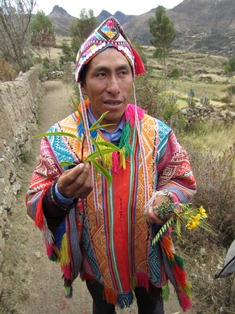
The next day we all went horseback riding, mountain biking and visited the houses of a couple community members who demonstrated how to make mud bricks (which are used for the creation of houses here), how to colour wool and weave, and how to use local plants are medicine for different ailments.  After these activities we ate a large feast and drank chicha (fermented corn). Now all was good with this tour and the community was very experienced in receiving guests, however, we may have found an area that needs attention.
Attention and improvements can always be made by anyone, or any organization everwhere in the world. This noticeable need for change we believe may be needed in the production of the chicha. After the final day Ronny, the TV host, and myself became very ill. I was put in the hospital with severe dehydration from a fever derived from a bacterial infection and I also had a parasite. This past week was not a pleasant one and was spent in my bed. These little occurrences are the risks that need to be eliminated from experiential tourism and must be stressed. This is something that we can stress and pay acute attention to when working with Media Luna. In Media Luna, one of the activities is the production of chicha. It is the responsibility of the community to deliver a safe product to the customers and it is the role of the communities’ support system to train methods of achieving this success.
Our road to the development of Media Luna is a long road, but the motions have been in play and we are  continuously bridging connections with hotels, and Urubamba.